Ultrasound Course Module 5
Biometry, Prenatal Diagnosis, and Doppler
Lesson 2: Biometry — Multiple Measurements (BPD/HC/AC/FL)
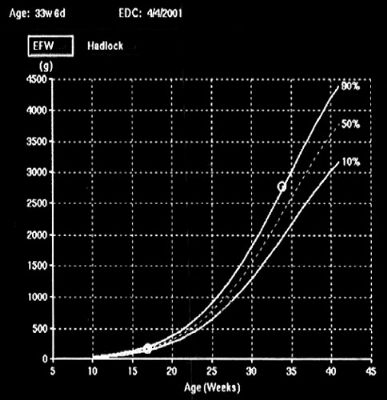
- Estimation of Fetal Weight
- Hadlock Nomogram: HC, AC, FL
- Shepard Nomogram: AC, FL
- 3 weeks minimum interval for growth studies
- Indirect measure of the variable of interest
- Fair predictor (+/- 10-15 %) in normal fetuses
- Poor predictor in LGA, SGA, or asymmetric fetuses
- Small Babies
- SGA (EFW < 5th percentile for ega)
- Etiology:
- 40-50% small but normal (no pathology)
- 30-40% uteroplacental etiology
- 10-20% maternal factors
- 5-10% fetal abnormality
- Growth — Restricted vs. Small-But-Normal
- HC/AC ratio:
- Highly predictive of IUGR in at-risk populations.
- Poorly predictive in normal populations.
- Reflects "head-sparing" effect.
- FL:AC — may reflect IUGR if abnormal.
- If low, may reflect IUGR (Hadlock FP, Deter RL, Harrist RB, Roecker E, Park SK. A date-independent predictor of intrauterine growth retardation: Femur length/abdominal circumference ratio. AJR Am J Roentgenol 1983;141(5):979-84)
- Oligohydramnios.
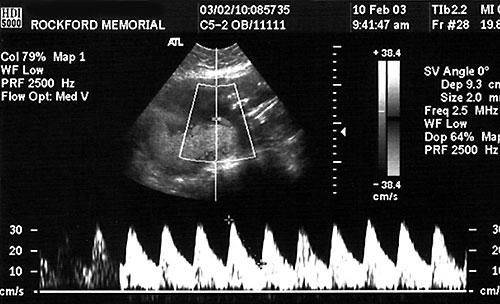
 Normal umbilical artery systolic
to diastolic ratio (S/D)
 Normal MCA of 52.9 cm seconds at
32 weeks in a Duffy sensitized patient
- Predisposing maternal conditions.
- Doppler velocimetry:
- Umbilical artery
- Cerebral artery
- Large Babies
- U/S EFW is very unreliable for large fetuses.
- U/S EFW is a poor predictor of:
- Abnormal labor progress
- Shoulder dystocia
- Actual birth weight (10-20% error rate)
- FL:AC — may reflect IUGR if abnormal.
- if high. may reflect macrosomia (Hadlock FP, Deter RL, Harrist RB, Roecker E, Park SK. A date-independent predictor of intrauterine growth retardation: Femur length/abdominal circumference ratio. AJR Am J Roentgenol 1983;141(5):979-84)
- Consider:
- Repeating glucose challenge (esp. w/increased fluid)
- Early Induction for macrosomia is questionable